Japanese companies in Northern Netherlands see their innovation puzzles solved
Can you create circular packaging from your own production waste? And how can you roast coffee using less natural gas? Kikkoman in Sappemeer and UCC in Bolsward needed help answering these questions. So they shared their challenges with the world through the TopDutch Innovation Challenge.
Challenge-based innovation in action
The TopDutch Innovation Challenge is a prime example of challenge-based innovation. The concept: connect large companies with a vision for sustainable innovation to solution providers with the expertise to make it happen.
Once a match is made, the two parties commit to working together over an extended period to co-develop a solution. NOM adds its expertise by scouting potential solvers, opening up its network, and supporting the process through its business developers and project managers. Together, these three parties bring all the ingredients needed to develop exciting new sustainable innovations—right here in the North.
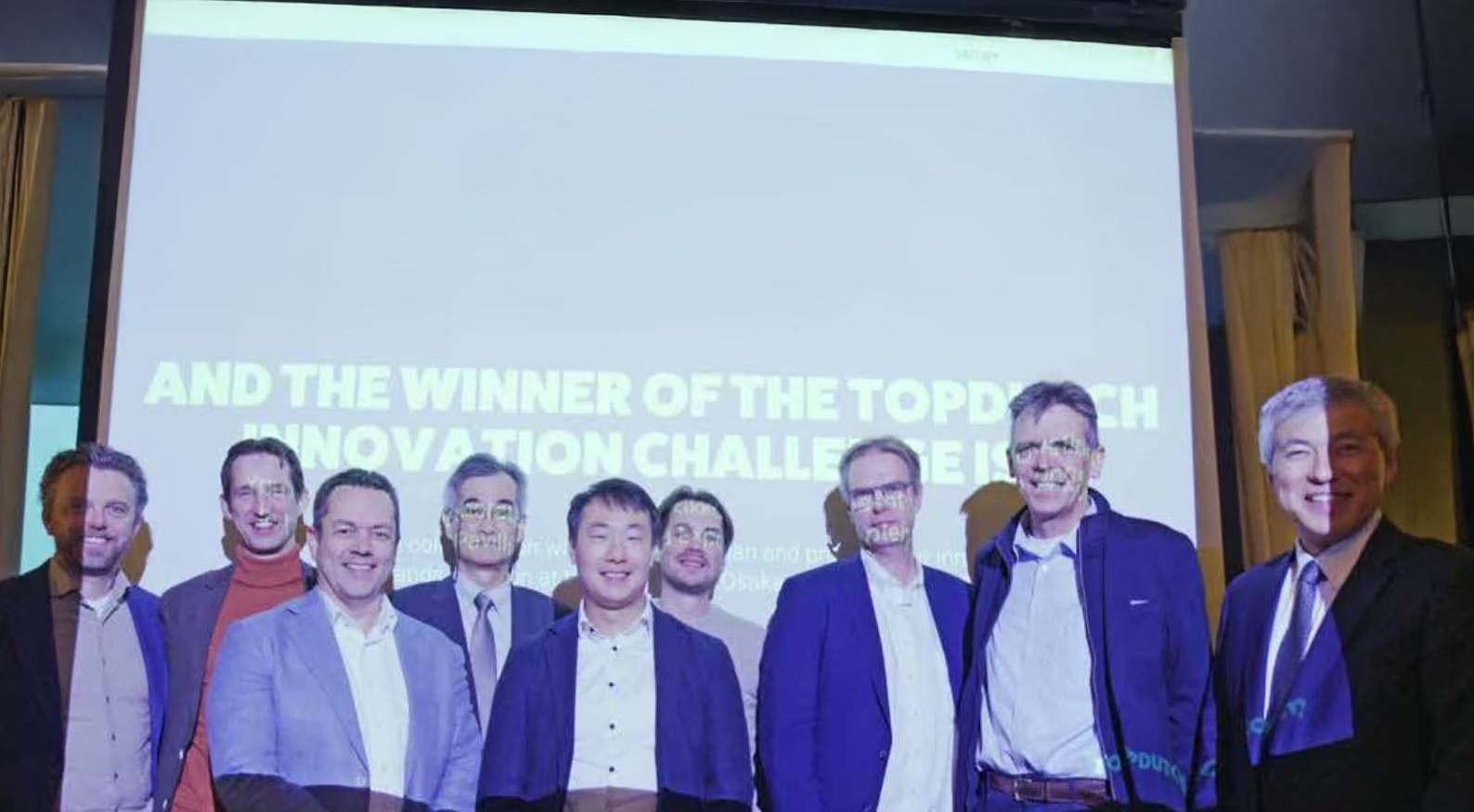
This round of the TopDutch Innovation Challenge launched in summer 2024. Two Japanese companies with operations in Northern Netherlands—soy sauce brand Kikkoman and coffee company UCC—shared their challenges via TopDutch’s channels and NOM’s network. Solutions came in from around the globe and were narrowed down to a shortlist of 2–3 solution providers per challenge. These companies pitched their ideas at a match event in Northern Netherlands, where Kikkoman and UCC announced which teams they would move forward with. So, what were the challenges—and who are the teams tackling them?
Kikkoman & Buyo Plastics
Soycake—that’s the name of the byproduct from soy sauce production. It’s already used as animal feed, but what if it could be turned into packaging for Kikkoman’s own soy sauce? That would upgrade the byproduct and reduce the use of plastic bottles. It aligns perfectly with Kikkoman’s ambition to operate as sustainably and circularly as possible. But how?
Enter Buyo Plastics, a Vietnam-based company. Daniël Verlinde, Buyo’s Manager Europe, convinced the leadership at Kikkoman’s European production facility with a short pitch. He explained how soycake could serve as an excellent base for biocomposite—a material that can be used to produce all kinds of packaging for soy sauce products. Verlinde even brought a prototype bottle made from another bio-waste material, complete with a Kikkoman logo, to visualize the potential outcome of their collaboration.
This is just a test version—I printed the label myself. But you can see it’s possible.
His hands-on approach and practical example gave Kikkoman the confidence to choose Buyo over other contenders: Greencovery and TripleW.
UNC and DNV/Summit
Coffee giant UCC, based in Bolsward, also found a match. Their challenge was addressed through a joint pitch by DNV, a Norwegian multinational with a branch in Northern Netherlands, and Summit Engineering from Eelde.
UCC wants to reduce its natural gas usage in coffee roasting and is exploring hydrogen as an alternative. DNV knows how to make that happen, says Johan Knijp, head of DNV’s technology center in Groningen. Together with Summit Engineering, he proposed a solution:
We believe UCC will benefit most from a flexible concept—one that gradually shifts from gas to hydrogen.
UCC’s leadership preferred this proposal over a strong pitch from Equans, which suggested a hybrid system using hydrogen and electricity.
On to the world stage
At the match event, Kikkoman & Buyo and UCC & DNV/Summit signed a symbolic Letter of Intent to formally explore collaboration in the coming months. Since then, the teams have been in regular contact. They’ll present their progress at the World Expo in Japan, one year after the Innovation Challenge was launched.
The World Expo will be held in Osaka in April 2025, with over 150 countries showcasing their best innovations. Under the theme “Common Ground,” Dutch-Japanese collaborations will take center stage. That’s why TopDutch focused this Innovation Challenge on Japanese companies in Northern Netherlands.
“The companies participating in this challenge will showcase their progress in the Dutch pavilion in Osaka,” explains Fleur Mulder, program manager of this and other Innovation Challenges.
A shift in mindset
Kikkoman & Buyo, UCC & DNV/Summit—these could be the start of breakthrough innovations. Remco van Leeuwen knows the potential. As project manager at New Born Rubber, he won a similar pitch last year to collaborate with Japanese company Teijin. “We’re still working together. We’ve made real progress in making mining conveyor belts more sustainable. By researching openly together, we’ve taken major steps.”
Ben Freyee from BASF agrees. The Swiss company, with a site in Heerenveen, joined the Sustainable Industry Challenge last year. They sought ways to reuse production waste and partnered with startups Aquacycl and Treatech.
It was exciting to think so differently. But our mindset has truly changed—and our focus on innovation is here to stay. That’s what a challenge like this can do.

