TopDutch challenge-based innovation takes the world stage at EXPO 2025 – UCC
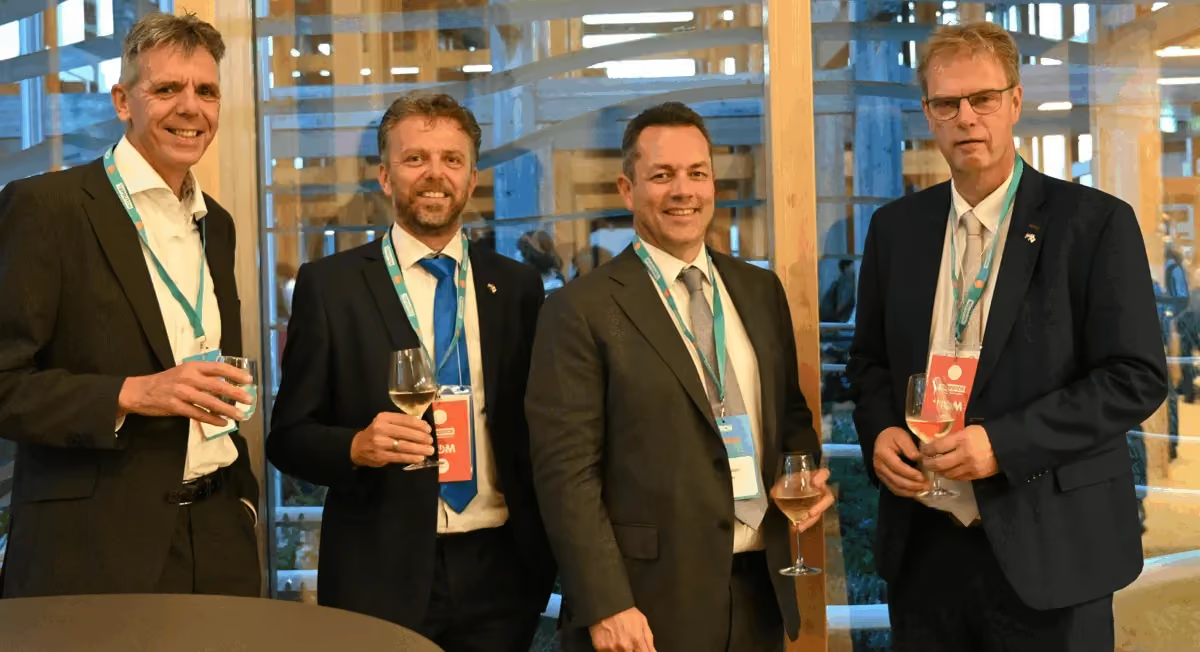
The NOM andTopDutch Innovation Event was a celebratory conclusion to the TopDutch Innovation Challenge. Participants in the TopDutch Innovation Challenge and the Chemport Sustainable Industry Challenge presented the results of their year-long experiment with challenge-based innovation in front of an audience ofCEOs and senior executives from ten Japanese companies with a location in the TopDutch region, representatives of the Dutch national government, and experts in R&D and sustainability.
As part of the Netherlands’ preparations for EXPO 2025, the NOM and TopDutch initiated theTopDutch Innovation Challenge over a year ago.
The WorldExpo, this year in Osaka, Japan, brings together countries, companies and innovators to showcase cutting-edge ideas, technologies and solutions for shaping a better future. Over 200,000 people a day visit the Expo to learn moreabout the innovations other countries are bringing to the world.
The theme of the Netherlands pavilion this year was ‘Common Ground, solving global challenges together’. It seemed like the perfect place, therefore, to showcase how challenge-based innovation projects in the TopDutch region are bringing Japanese excellence together with worldwide innovation, by applying the Dutch culture of collaboration. Here, we’re working together on common ground to find solutions to sustainability challenges.
The NOM’s model of challenge-based innovation involves taking a large company with a vision for an innovation that would make their processes more sustainable, and matching them with a party who has the expertise to realize it. The match is found through a competition-style process, with companies from around the world pitching their unique perspectives and ideas.
Once a match is made, the two parties agree to bring their heads together and collaborate for an extended period on a solution to this sustainability challenge. The NOM adds its expertise in order to scout for potential solution providers, provide access to its network, and offer the support of its business developers and project managers.
Fleur Mulder, Strategist at the NOM, says that this model of innovation works particularly well in the TopDutch region. “Our culture is based on equality and openness. People like to work together. Large companies and small companies see each other as true partners; they really are willing to work from each other. And that makes it a very good start for challenge-based innovation."
“We have strong and well-connected networks, within our region, with the other organizations that are in our ecosystem, but also on a national scale. And internationally. So we can even scout directly in the countries where we are looking for a specific innovation."
“That international outlook really helps us. International companies actually make up 18% of our country’s GDP. So, we’re very happy to keep them here, and to help them innovate and grow even further”.
Roasting coffee with hydrogen
Japanese coffee producer UCC was one of the participants in the TopDutch Innovation Challenge. Their largest plant in Europe, located in Bolsward in Friesland, was looking for new ways to make their coffee production more sustainable. “We were actively exploring greener options, preparing for a future without natural gas,” explained Jeroen de Jager, Site Director at UCC Benelux.
The city of Bolsward has a strong development project to support the new hydrogen economy, so they were already located in a good spot to use hydrogen as a more sustainable energy source for their coffee roasters. But the challenge is that the costs of hydrogen is not yet commercially sustainable. What if they could retrofit their largest roaster – which produces 18 million kilograms of coffeeannually – to be able to roast on hydrogen and natural gas?
Jeroen de Jager explains “Having a roaster that can run on both gases means that we canactually transition and not, in one go, move to hydrogen. And gain new experience in hydrogen while maintaining operational flexibility. Sowe learn from what it does, instead of a big bang and moving straight to hydrogen roasted coffee”.
Using thechallenge-based innovation model, UCC were able to ask that question to the world. NOM supported them to formulate the challenge question, scout their international network, and make a selection of the most interesting respondents. The advantage of challenge-based innovation is that one question can have many different answers, so you are able to reflect on ideas from a wide array of potential solution-providers and maybe even get an answer totally out-of-the-box.
For UCC, it turned out that the right solution happened to be quite close to home. DNV and Summit, both with locations in Groningen, also in the TopDutch region, teamed up and were one of the applicants. “When the challenge came out, we felt immediately that it was a perfect fit for us”, said Johan Knijp, Business Development Lead at DNV. “We signed up right away”.
“We joined together with Summit Engineering because UCC were not only looking fortechnical validation but also a practical implementation. And that is where Summit is really strong”.
Robbert vander Pluijm, Founder of Summit Engineering explained how the three parties worked so well together. “We mainly listened to the question from UCC, looked at the local conditions and then explored what everyone does best”.
What follows in the NOM’s model of challenge-based innovation is a long process of cooperation, testing and validation. “The process doesn’t stop at the match, like ‘oh good luck! You found each other, that’s great, and from here on your own", says Fleur Mulder, Strategist at the NOM. “We like to stay with both parties, help them develop, help them set up a project plan and at the end we celebrate at a demo day”.
In the case of the TopDutch Innovation Challenge, that demo day was celebrated at the event at the Expo in Osaka. And, around a year after the challenge-process was initiated, there was a lot to celebrate. A few weeks earlier, the team had successfully roasted coffee beans using various blends of hydrogen and natural gas, including blends fully roasted on hydrogen - demonstrating the potential of cleaner coffee production.
“The energy transition is so big!” Robbert van der Pluijm reflected. “So if you can create a collaboration like this, and then also make it successful, isn’t that amazing”.
Strengtheningties between Japan and the TopDutch region
The event at the World Expo was also a chance to deepen the relationships between theTopDutch region and Japan. Dina Boonstra, Managing Director of the NOM, joined a Leaders’ Luncheon at the Netherlands Pavilion together with CEOs and senior executives from 10 Japanese companies with a location in the Northern Netherlands, as well as Esther Pijs, Director General of Green Growth Realisation from the Dutch Ministry of Climate and Green Growth, and the outgoing- and incoming- Consul Generals of the Kingdom of the Netherlands inOsaka, Marc Kuipers and Sandra Pellegrom, respectively.
She saw first-hand the positive reactions of these Japanese leaders. According to her, one emphasized how valuable the meeting was. Not only because of the initiative itself, but also because it allowed him to connect with fellow CEOs from other multinationals, which he found to be a unique opportunity.
Dr Takuya Sato, General Manager of Kikkoman Europe R&D Laboratory also made apresentation about innovating in the TopDutch region. He told the EXPO about two research projects they are working on, and how they are supported by local talent and government.
Fleur Mulders thinks the event was a great success. “In the TopDutch region, we’re proud that we host some very innovative, sustainability-focused multinationals. We wanted to remind these busy leaders of the chances that their location in the Northern Netherlands can offer them, and to show them how we’re willing tofind exciting new ways to work together to achieve growth both for them and the region. We hope they’ve come out feeling inspired, and maybe even wanting to start their own innovation challenge with us”.
The challenge

Innovation Challenge – UCC Coffee
Are you working in hydrogen management or energy infrastructure, and do you have the expertise and technology to help UCC prepare one of their coffee roasters for hydrogen? Would you like to secure a new client and showcase your innovation on the global stage at the World Expo in Japan?
