Chemport SIC challenge-based innovation takes the world stage at EXPO 2025 – Teijin Aramid
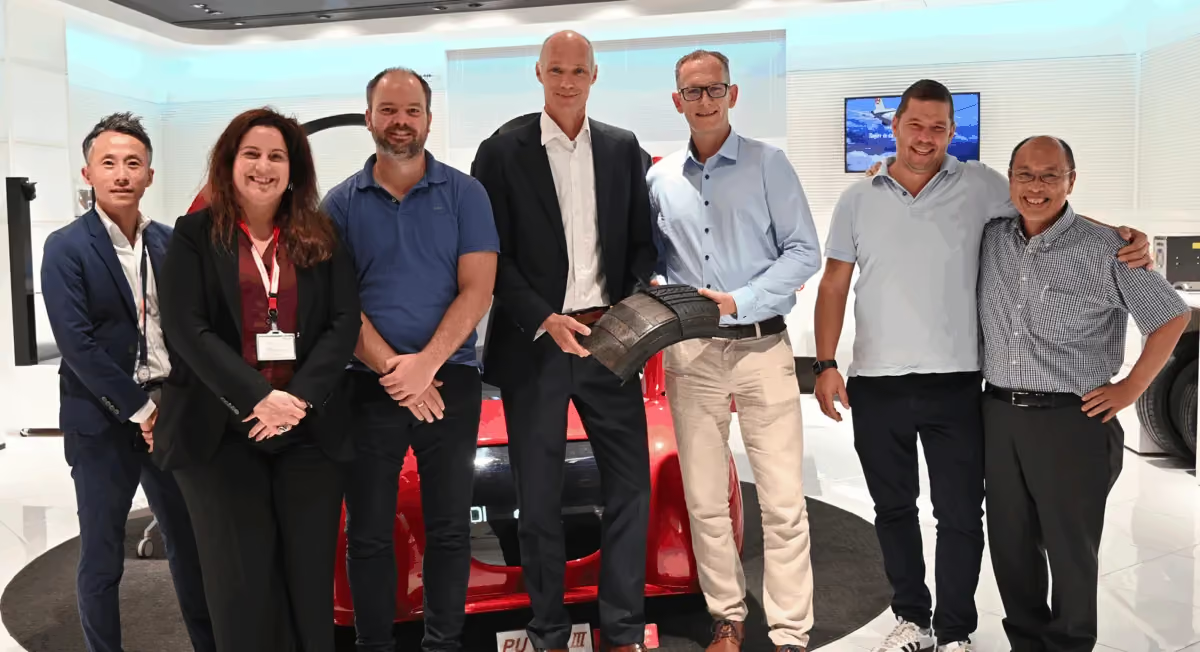
The NOM andTopDutch Innovation Event was a celebratory conclusion to the TopDutch Innovation Challenge. Participants in the TopDutch Innovation Challenge and the Chemport Sustainable Industry Challenge presented the results of theiryear-long experiment with challenge-based innovation in front of an audience of CEOs and senior executives from ten Japanese companies with a location in the TopDutch region, representatives of the Dutch national government, and experts in R&D and sustainability.
As part ofthe Netherlands’ preparations for EXPO 2025, the NOM and TopDutch initiated theTopDutch Innovation Challenge over a year ago.
The World Expo, this year in Osaka, Japan, brings together countries, companies andinnovators to showcase cutting-edge ideas, technologies and solutions for shaping a better future. Over 200,000 people a day visit the Expo to learn more about the innovations other countries are bringing to the world.
The theme of the Netherlands pavilion this year was ‘Common Ground, solving global challenges together’. It seemed like the perfect place, therefore, to showcase how challenge-based innovation projects in the TopDutch region are bringing Japanese excellence together with worldwide innovation, by applying the Dutch culture of collaboration. Here, we’re working together on common ground to find solutions to sustainability challenges.
The NOM’s model of challenge-based innovation involves taking a large company with avision for an innovation that would make their processes more sustainable, andmatching them with a party who has the expertise to realize it. The match isfound through a competition-style process, with companies from around the worldpitching their unique perspectives and ideas.
Once a match is made, the two parties agree to bring their heads together andcollaborate for an extended period on a solution to this sustainabilitychallenge. The NOM adds its expertise in order to scout for potential solutionproviders, provide access to its network, and offer the support of its businessdevelopers and project managers.
Fleur Mulder, Strategist at the NOM, says that this model of innovation works particularly well in the TopDutch region. “Our culture is based on equality and openness. People like to work together. Large companies and small companies see each other as true partners; they really are willing to work from each other. And that makes it a very good start for challenge-based innovation."
“We have strong and well-connected networks, within our region, with the otherorganizations that are in our ecosystem, but also on a national scale. And internationally. So we can even scout directly in the countries where we arelooking for a specific innovation. That international outlook really helps us. International companies actually make up18% of our country’s GDP. So, we’re very happy to keep them here, and to helpthem innovate and grow even further”.
Creating circular conveyor belts
Conveyor belts. Of course, a closed loop by shape. But their material usage is, in general, much less of a closed loop. Most conveyor belts that are used in mining end up being dumped somewhere in the mine site when they are no longer usable. Teijin Aramid, a TopDutch-based subsidiary of the Japanese giant Teijin wanted to be able to recover their aramid fibers from end-of-life conveyorbelts.
To do that,they also looked towards challenge-based innovation, and signed-up for the Chemport Sustainable Industry Challenge, also jointly organized by the NOM. During the event in Osaka, they presented their experience with this form of problem solving together with their winning solution provider, New Born Rubber.
“I went to Delfzijl, to the Teijin [Aramid] factory, and we had a contest there with other challenge particpants” Remco van Leeuwen, Project Manager at New Born Rubber, told the audience. “There, we spoke with four people, it was a nice afternoon, and after the afternoon I went home with a good feeling about it.The next evening, the winners were announced and we were the winner. So a few weeks later, we signed an NDA, had a few meetings and we have a collaboration between Teijin Aramid and New Born Rubber”.
New BornRubber is a TopDutch-based start-up that span-out of the University ofGroningen. Their winning pitch to Teijin Aramid involved a plan for TeijinAramid to collect end-of-life conveyor belts from their customers, and afterthat for New Born Rubber to separate the aramid and the rubber from each other.They next make the aramid as clean as possible, deliver the fibers to Teijinand process the waste rubber and send it back to the rubber company. “And after that, scale-up and close the circular chain for recycling conveyor belts,” continued van Leeuwen. “And the market is huge! Especially if you know that10-15% of a transport belt is aramid and the rest is rubber”.
Gerwin Elderman, R&D Application Engineer Technical Fibers at Teijin Aramid
According to Gerwin Elderman, R&D Application Engineer Technical Fibers at TeijinAramid, their participation in the Chemport Sustainable Industry Challenge was a great success. “The collaboration with New Born Rubber showed us that there claiming of Twaron from conveyor belts is possible. We are able to use thefirst reclaimed Twaron fibers, in good comparison with virgin Twaron fibers. We also have the full commitment of some main customers of Teijin Aramid for theconveyor belt recycling.This fulfils our ambitions to be the best aramid producer for the world. We would definitely participate in a challenge like this again. The best innovations happen together”.
For New Born Rubber, they see great opportunities to grow the collaboration that formed during the Challenge. “At this moment we are engineering a pilot installation, and we aim to make the first test rounds before summer 2026,” says Remco van Leeuwen. “The growth potential is enormous, and may eventually ensure that we will open factories in other continents together with Teijin Aramid. For us, it was a positive experience, and if we were asked again, we would join immediately."
Strengthening ties between Japan and the TopDutch region
The event at the World Expo was also a chance to deepen the relationships between the TopDutch region and Japan. Dina Boonstra, Managing Director of the NOM, joined a Leaders’ Luncheon at the Netherlands Pavilion together with CEOs and senior executives from 10 Japanese companies with a location in the Northern Netherlands, as well as Esther Pijs, Director General of Green Growth Realisation from the Dutch Ministry of Climate and Green Growth, and the outgoing- and incoming- Consul Generals of the Kingdom of the Netherlands in Osaka, Marc Kuipers and Sandra Pellegrom, respectively.
She saw first-hand the positive reactions of these Japanese leaders. According to her, one emphasized how valuable the meeting was. Not only because of the initiative itself, but also because it allowed him to connect with fellow CEOs from other multinationals, which he found to be a unique opportunity.
Dr Takuya Sato, General Manager of Kikkoman Europe R&D Laboratory also made apresentation about innovating in the TopDutch region. He told the EXPO about two research projects they are working on, and how they are supported by local talent and government.
Fleur Mulders thinks the event was a great success. “In the TopDutch region, we’re proud that we host some very innovative, sustainability-focused multinationals. We wanted to remind these busy leaders of the chances that their location in the Northern Netherlands can offer them, and to show them how we’re willing tofind exciting new ways to work together to achieve growth both for them and the region. We hope they’ve come out feeling inspired, and maybe even wanting to start their own innovation challenge with us”.

